
NeuroStar TMS Therapy for Military & Veterans
Another treatment option when depression persists.
Military service asks a great deal, and so can the return to civilian life. When depression stays and antidepressant medication hasn’t brought enough relief, TMS is a non‑medication treatment to consider.

What TMS treatment involves
Non-invasive
No surgery. Nothing enters the body.
Outpatient
An office visit, then on with your day.
No anesthesia
You stay awake throughout.
Non-medication
Magnetic pulses, not another prescription.
In uniform
Depression can affect every part of life.
It can dull your focus on duty, wear down sleep and patience, and leave you in the room with the people you love without feeling fully there.
Depression is a medical condition, not a lapse in discipline or strength. It is treatable, and looking into treatment is one way of looking after the people who count on you.

After service
Mental health beyond active service.
Leaving the service changes the shape of a day, the people around you and, for many, a sense of purpose. Depression can surface in that transition, or years after it.
Whenever it surfaces, it is worth a conversation with a psychiatrist about what could help.

NeuroStar TMS
A different approach to depression treatment
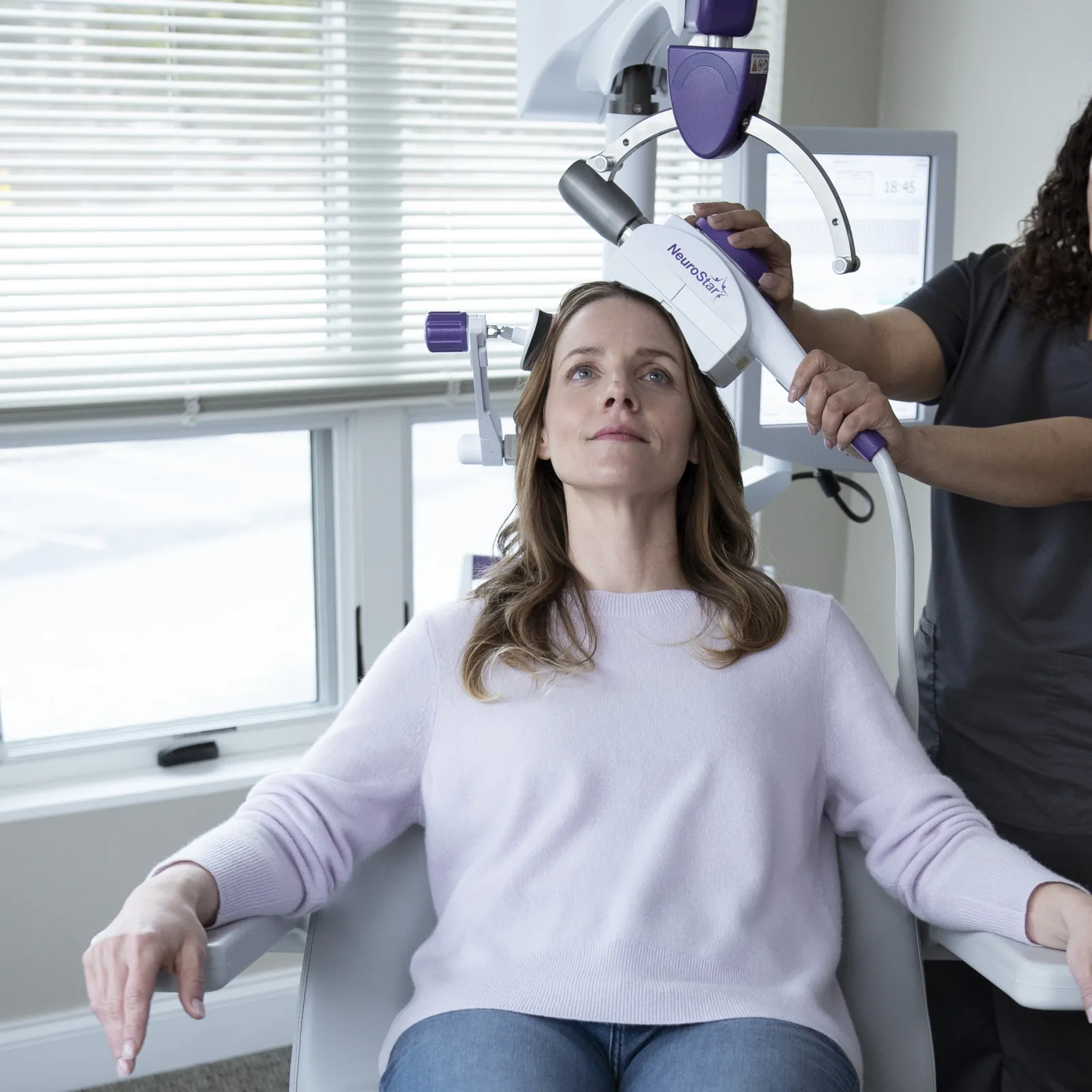
Focused magnetic pulses stimulate the areas of the brain involved in mood.
A non-medication treatment for adults whose depression hasn’t improved enough with antidepressant medication.
Take the self-assessment
At Atlantic Psychiatric Centers, TMS is delivered with the NeuroStar Advanced Therapy system.
Clinically demonstrated results
83%
saw their depression improve
62%
reached remission
Of 615 adults with major depressive disorder who completed a course of NeuroStar treatment in everyday clinical practice, as rated by their clinicians. Patients could also be taking medication. Individual results vary. Sackeim HA, et al. Journal of Affective Disorders. 2020;277:65–74. View on PubMed
Explore the science behind NeuroStar TMSInsurance coverage
We work with these insurers and check your benefits for you, so you know what your plan covers before you decide anything.





Coverage varies by plan. Medicaid is not accepted.
TMS self-assessment
Take the self-assessmentA depression questionnaire hosted by NeuroStar. It is not a diagnosis. It asks for your date of birth and contact details, and for your agreement to be contacted by Atlantic Psychiatric Centers.
Indications and important safety information
Indications
The NeuroStar Advanced Therapy System is indicated for the treatment of depressive episodes and for decreasing anxiety symptoms for those who may exhibit comorbid anxiety symptoms in adult patients suffering from Major Depressive Disorder (MDD) and who failed to achieve satisfactory improvement from previous antidepressant medication treatment in the current episode.
The NeuroStar Advanced Therapy System is intended to be used as an adjunct for the treatment of adult patients suffering from Obsessive-Compulsive Disorder (OCD).
NeuroStar Advanced Therapy is indicated as an adjunct for the treatment of Major Depressive Disorder (MDD) in adolescent patients (15-21).
Important safety information
NeuroStar Advanced Therapy is only available by prescription. A doctor can help decide if NeuroStar Advanced Therapy is right for you. Patients’ results may vary.
The most common side effect is pain or discomfort at or near the treatment site. These events are transient; they occur during the TMS treatment course and do not occur for most patients after the first week of treatment. There is a rare risk of seizure associated with the use of TMS therapy (<0.1% per patient).
NeuroStar Advanced Therapy should not be used with patients who have non-removable conductive metal in or near the head. NeuroStar Advanced Therapy has not been studied in patients who have not received prior antidepressant treatment.
Visit neurostar.com for full safety and prescribing information.
Ready to explore your options?
Call us and say you’d like to talk about TMS. We take it from there.