
The science behind NeuroStar TMS Therapy
A closer look at how the treatment works and what the clinical research has found.
Understanding depression and brain activity
Brain-imaging studies have found that in many people with depression, some of the regions that help regulate mood, motivation and concentration are less active than in people without it.
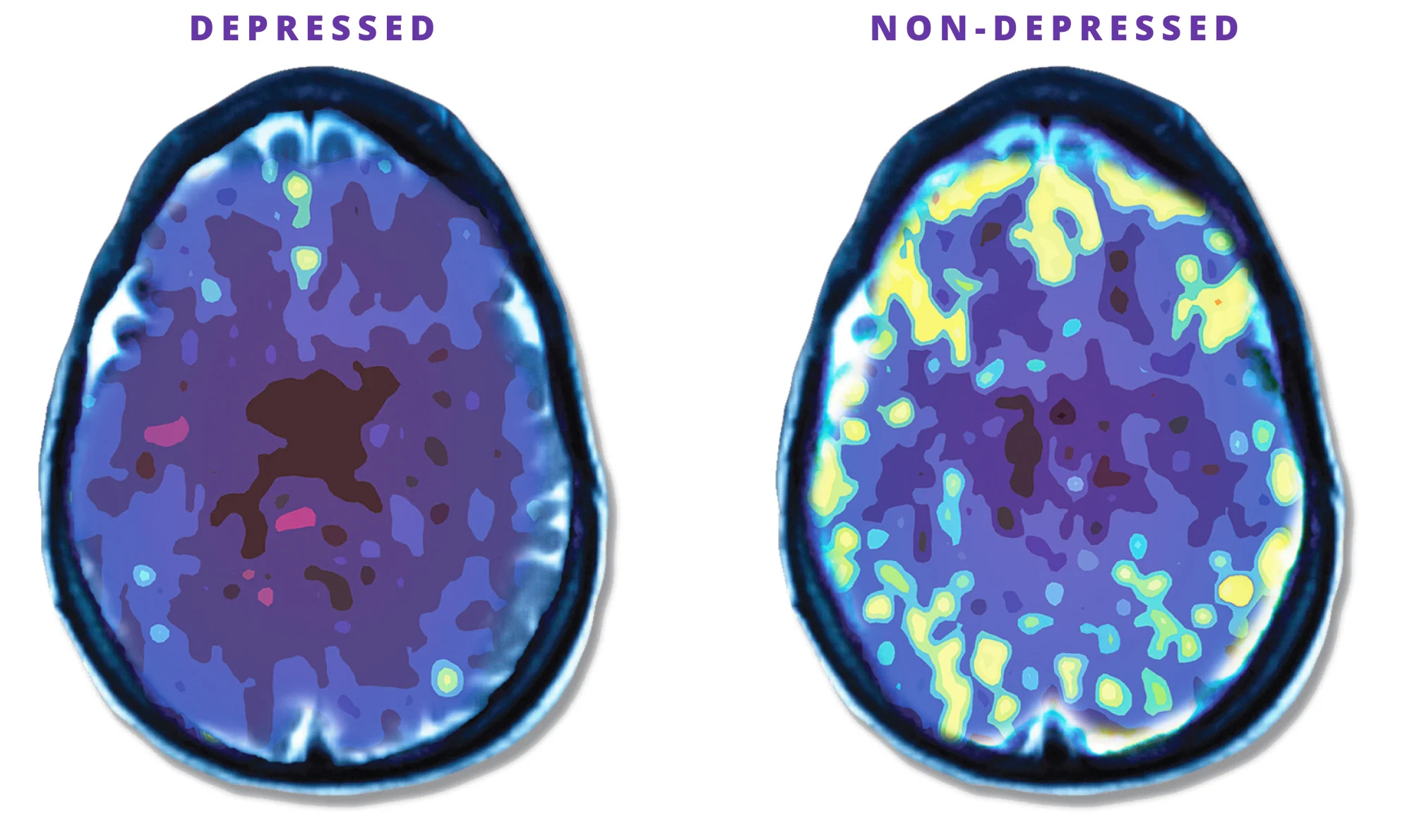
PET scans of two different adults, not one person before and after treatment. Brighter colors mark higher activity.
Mark George, MD, Biological Psychiatry Branch, Division of Intramural Research Programs, NIMH, 1993.
How TMS works
Transcranial magnetic stimulation (TMS) uses brief magnetic pulses to stimulate the areas of the brain involved in mood.
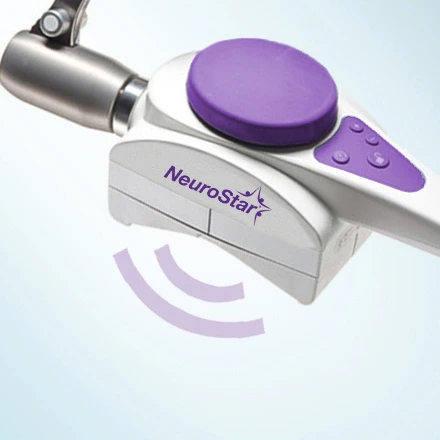
Generate
The treatment coil produces brief, focused magnetic pulses.
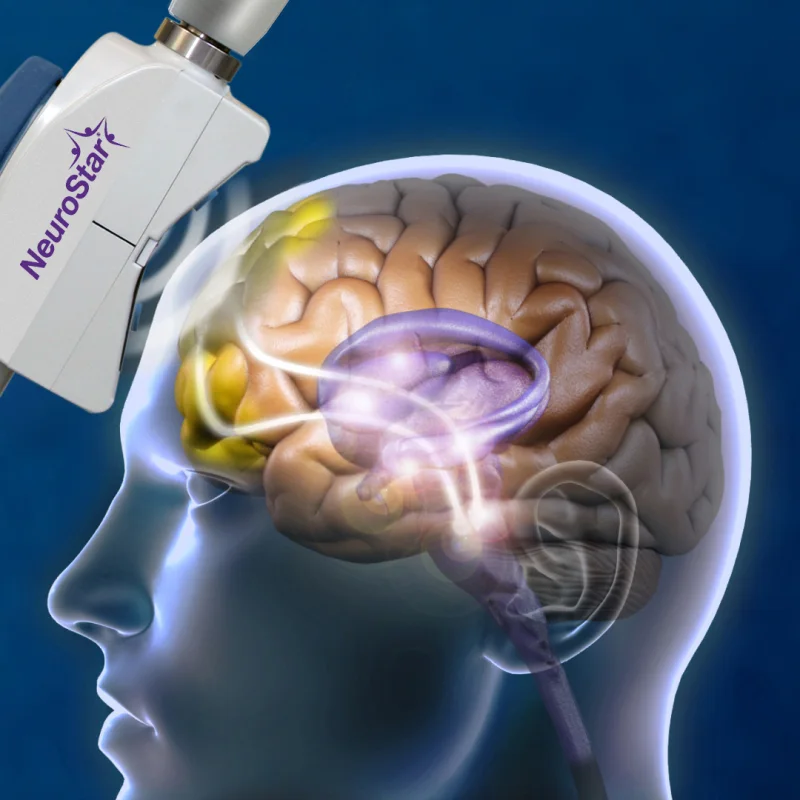
Stimulate
The pulses pass through the skull and induce a small electrical current in the brain tissue beneath.
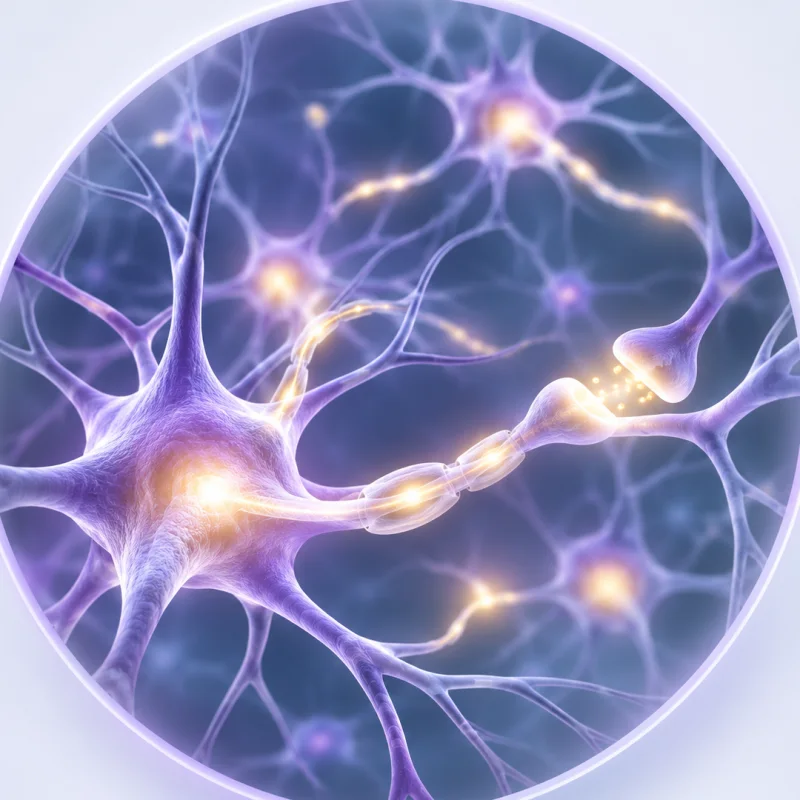
Influence
The current makes nerve cells fire. Repeated, it is thought to change how mood networks work together.
The NeuroStar technology
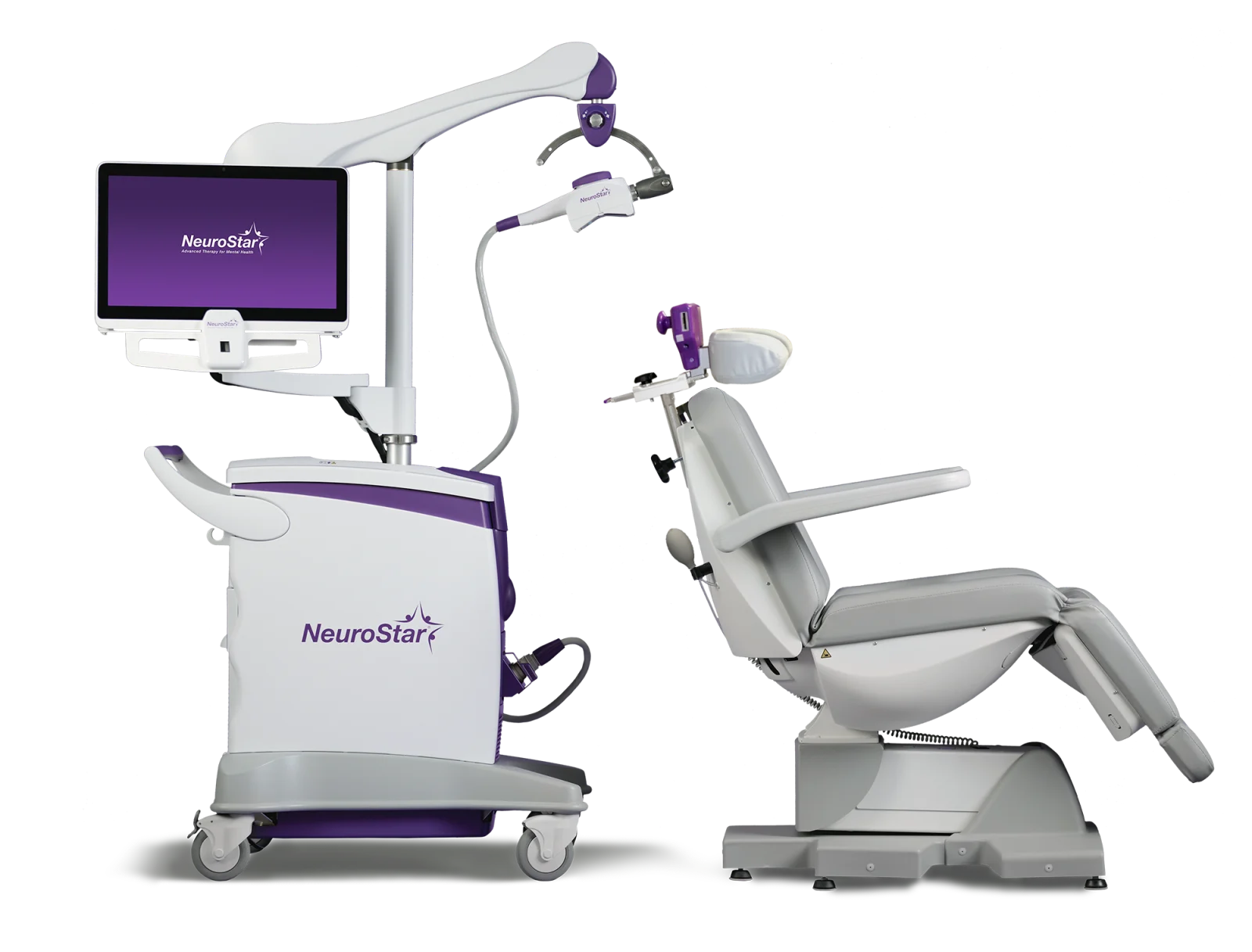
The NeuroStar system holds its treatment coil in position against the head for each session. Your physician determines the placement and strength of your treatment.
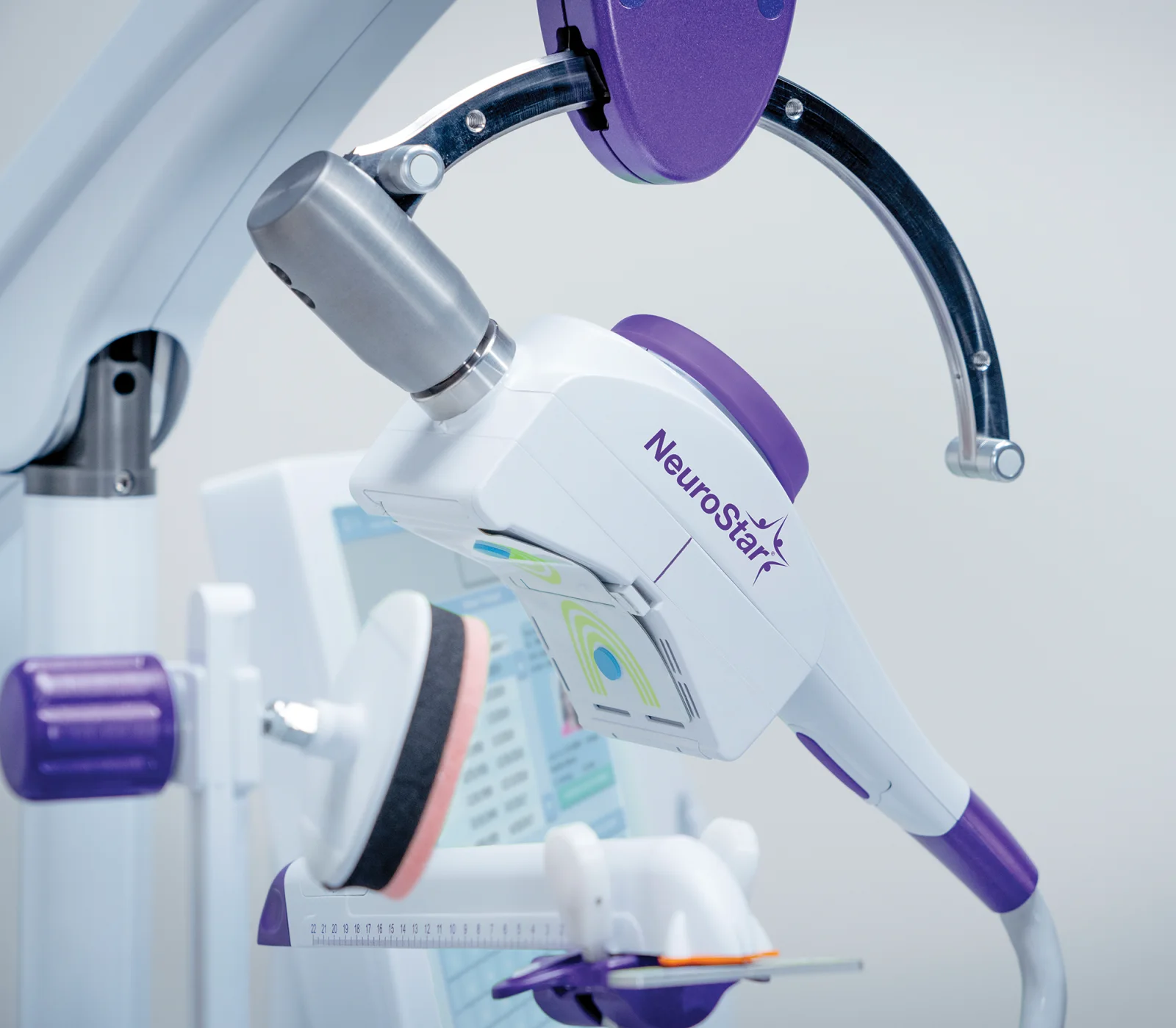
At Atlantic Psychiatric Centers, TMS is delivered with the NeuroStar Advanced Therapy system.
- 2008
- FDA-cleared for adults whose depression had not improved with antidepressant medication.
- 2024
- Clearance extended to ages 15 to 21, as an addition to other care.
See how it works
A one-minute animation from NeuroStar, captioned throughout.
Read the transcript
How does NeuroStar work?
In this short, in-office treatment a cushioned coil is precisely positioned on the head.
NeuroStar therapy is delivered directly to the part of the brain associated with depression at the correct therapeutic location and depth, each and every time.
Magnetic pulses, similar in strength to an MRI, electrically activate precise regions of the brain.
These electrical impulses travel through brain circuits, delivering their therapeutic effect, strengthening connections.
This increases the release of neurotransmitters, activating areas of the brain that affect mood and re-linking networks between regions of the brain.
Over a full course of treatment, over 100,000 pulses are delivered.
Studies have shown this pattern of repeated stimulation can promote neuroplasticity, which is the brain’s ability to adapt and change, and contributes to the treatment’s long-lasting effects.
Clinically demonstrated results
In adults
83%
saw their depression improve
62%
reached remission
Of 615 adults with major depressive disorder who completed a course of NeuroStar treatment in everyday clinical practice, as rated by their clinicians. Patients could also be taking medication. Individual results vary. Sackeim HA, et al. Journal of Affective Disorders. 2020;277:65–74. View on PubMed
In adolescents and young adults
78%
saw their depression improve
48%
reached remission
Of 77 patients aged 12 to 21 with major depressive disorder who completed a course of NeuroStar treatment in everyday clinical practice, as rated by their clinicians. Individual results vary. Croarkin PE, et al. JAACAP Open. 2025;3(4):1246–1258. View on PubMed
Key research and clinical studies
O’Reardon et al., 2007
Randomized, sham-controlled trial
View on PubMedAmong 301 adults, real TMS did better than a sham on most depression measures, and by week 6 about twice as many reached remission.
Limitation: The main measure fell just short of significance until six patients were excluded afterward.
George et al., 2010
Randomized, sham-controlled trial
View on PubMedAmong 190 adults, 14.1% reached remission with real TMS, against 5.1% with a sham.
Limitation: Tested TMS on its own, without antidepressant medication.
Carpenter et al., 2012
Observational study
View on PubMedAmong 307 adults at 42 clinics, clinicians rated 58% improved and 37% in remission.
Limitation: No comparison group.
Dunner et al., 2014
Observational study, 12 months
View on PubMedOf 120 adults who had improved, 62.5% stayed improved through the following year, by their own ratings.
Limitation: No comparison group; about a third had further TMS during the year.
Sackeim et al., 2020
Registry study
View on PubMedAmong 5,010 adults, 58% to 83% improved and 28% to 62% reached remission. The highest figures are clinicians’ ratings of patients who completed treatment.
Limitation: No comparison group.
Croarkin et al., 2021
Randomized, sham-controlled trial
View on PubMedAmong 103 patients aged 12 to 21, real TMS (41.7% improved) was not significantly better than a sham (36.4%).
Limitation: Tested TMS on its own, without antidepressant medication.
Croarkin et al., 2025
Registry study
View on PubMedAmong 1,283 patients aged 12 to 21, 56% improved and 28% reached remission by their own ratings.
Limitation: No comparison group; side effects were not recorded.
TMS self-assessment
Take the self-assessmentA depression questionnaire hosted by NeuroStar. It is not a diagnosis. It asks for your date of birth and contact details, and for your agreement to be contacted by Atlantic Psychiatric Centers.
Indications and important safety information
Indications
The NeuroStar Advanced Therapy System is indicated for the treatment of depressive episodes and for decreasing anxiety symptoms for those who may exhibit comorbid anxiety symptoms in adult patients suffering from Major Depressive Disorder (MDD) and who failed to achieve satisfactory improvement from previous antidepressant medication treatment in the current episode.
The NeuroStar Advanced Therapy System is intended to be used as an adjunct for the treatment of adult patients suffering from Obsessive-Compulsive Disorder (OCD).
NeuroStar Advanced Therapy is indicated as an adjunct for the treatment of Major Depressive Disorder (MDD) in adolescent patients (15-21).
Important safety information
NeuroStar Advanced Therapy is only available by prescription. A doctor can help decide if NeuroStar Advanced Therapy is right for you. Patients’ results may vary.
The most common side effect is pain or discomfort at or near the treatment site. These events are transient; they occur during the TMS treatment course and do not occur for most patients after the first week of treatment. There is a rare risk of seizure associated with the use of TMS therapy (<0.1% per patient).
NeuroStar Advanced Therapy should not be used with patients who have non-removable conductive metal in or near the head. NeuroStar Advanced Therapy has not been studied in patients who have not received prior antidepressant treatment.
Visit neurostar.com for full safety and prescribing information.
Ready to explore NeuroStar TMS Therapy?
Call us and say you’d like to talk about TMS. We take it from there.