
NeuroStar TMS Therapy for Adolescents
Another treatment option for ages 15–21.
Depression can make school, friendships and family life harder than they should be. NeuroStar TMS is a non‑invasive treatment that can be added to the depression care a young person already has.

What TMS treatment involves
Ages 15–21
FDA-cleared as an add‑on treatment for depression.
Non-invasive
No surgery. Nothing enters the body.
Outpatient
An office visit, then on with your day.
No anesthesia
You stay awake throughout.
In daily life
When depression gets in the way of growing up.
Depression is more than a low mood. It can make it harder to keep up with school, enjoy time with friends, stay motivated or feel like yourself.
It is not a phase or a lack of effort. Depression is a medical condition, and when the care a young person has isn’t bringing enough relief, there is more to ask about.

NeuroStar TMS
A different approach to adolescent depression
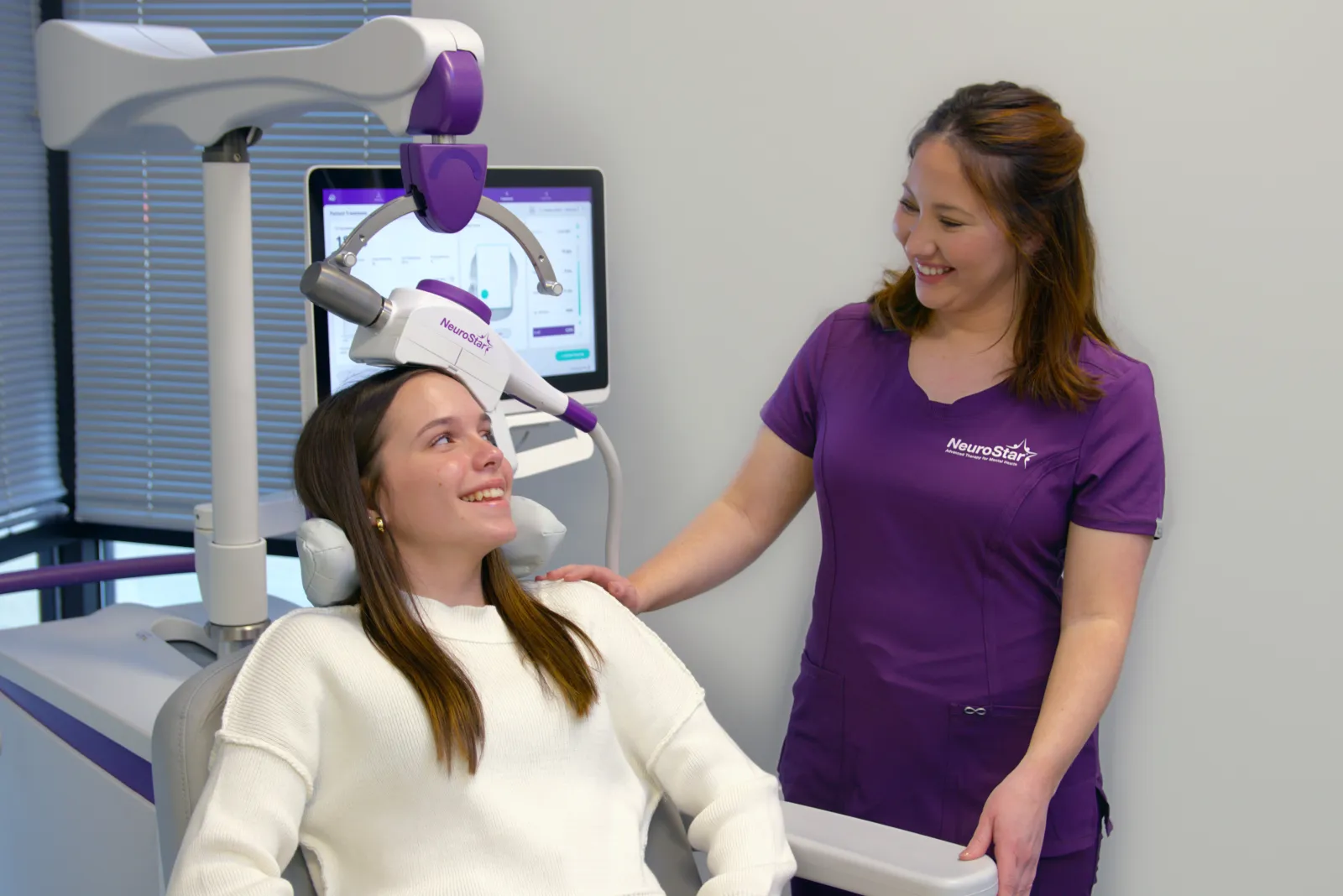
Focused magnetic pulses stimulate the areas of the brain involved in mood.
For ages 15 to 21, NeuroStar TMS is added to the depression care a young person already has. It does not replace it.
Take the self-assessment
At Atlantic Psychiatric Centers, TMS is delivered with the NeuroStar Advanced Therapy system.
Clinical results in adolescents
78%
saw their depression improve
48%
reached remission
Of 77 patients aged 12 to 21 with major depressive disorder who completed a course of NeuroStar treatment in everyday clinical practice, as rated by their clinicians. Individual results vary. Croarkin PE, et al. JAACAP Open. 2025;3(4):1246–1258. View on PubMed
Explore the science behind NeuroStar TMSDuring treatment
Treatment that fits into everyday life.
Sessions are outpatient visits over several weeks. There is no anesthesia and no sedation, so the rest of the day is still there afterward: school, practice, home.
Deciding on treatment is something a young person and their family do together with a psychiatrist, and we welcome parents and caregivers in that conversation.

Insurance coverage
We work with these insurers and check your benefits for you, so you know what your plan covers before you decide anything.





Coverage varies by plan, and not every plan covers TMS for adolescents. Medicaid is not accepted.
TMS self-assessment
Take the self-assessmentA depression questionnaire hosted by NeuroStar. It is not a diagnosis. It asks for your date of birth and contact details, and for your agreement to be contacted by Atlantic Psychiatric Centers.
Indications and important safety information
Indications
The NeuroStar Advanced Therapy System is indicated for the treatment of depressive episodes and for decreasing anxiety symptoms for those who may exhibit comorbid anxiety symptoms in adult patients suffering from Major Depressive Disorder (MDD) and who failed to achieve satisfactory improvement from previous antidepressant medication treatment in the current episode.
The NeuroStar Advanced Therapy System is intended to be used as an adjunct for the treatment of adult patients suffering from Obsessive-Compulsive Disorder (OCD).
NeuroStar Advanced Therapy is indicated as an adjunct for the treatment of Major Depressive Disorder (MDD) in adolescent patients (15-21).
Important safety information
NeuroStar Advanced Therapy is only available by prescription. A doctor can help decide if NeuroStar Advanced Therapy is right for you. Patients’ results may vary.
The most common side effect is pain or discomfort at or near the treatment site. These events are transient; they occur during the TMS treatment course and do not occur for most patients after the first week of treatment. There is a rare risk of seizure associated with the use of TMS therapy (<0.1% per patient).
NeuroStar Advanced Therapy should not be used with patients who have non-removable conductive metal in or near the head. NeuroStar Advanced Therapy has not been studied in patients who have not received prior antidepressant treatment.
Visit neurostar.com for full safety and prescribing information.
Explore treatment options together.
Call us and say you’d like to talk about TMS. We take it from there.